
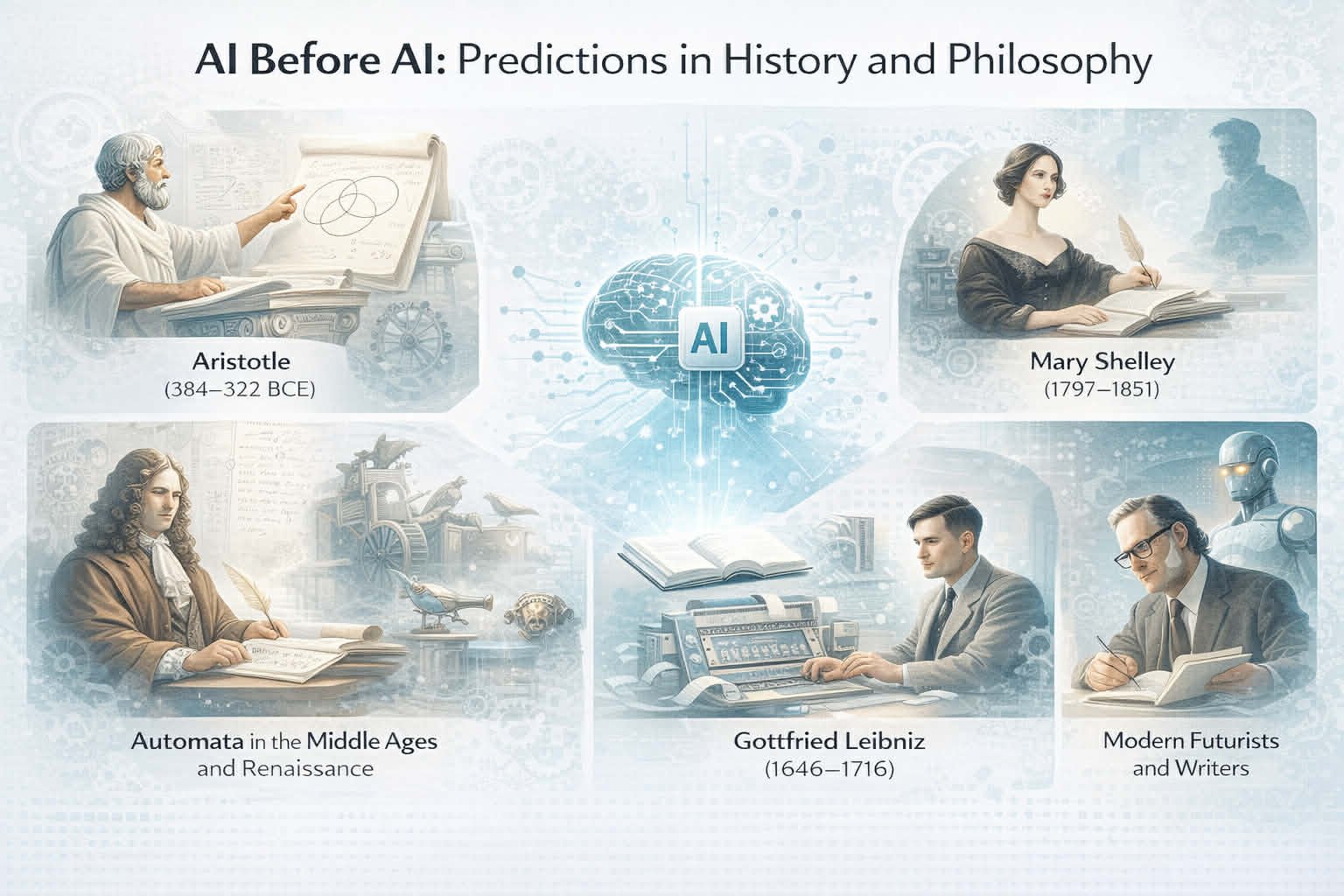
The concept of artificial intelligence was not born in a Silicon Valley garage in the 2010s. Long before computers existed, humanity’s greatest minds pondered whether machines could think, reason, and replicate human cognition. The quest to create intelligent machines is not a 21st-century obsession—it is a centuries-old dream that evolved through philosophical inquiry, mechanical ingenuity, and scientific advancement [1].
Today, as we witness the exponential growth of AI technologies powering everything from chatbots to autonomous systems, it is worth tracing how the predictions of ancient philosophers, Renaissance engineers, and 20th-century visionaries laid the intellectual groundwork for today’s AI revolution.
The Philosophical Roots: Ancient Greece and Formal Logic
The story of artificial intelligence predictions begins not with transistors or algorithms, but with one of history’s greatest thinkers: Aristotle (384–322 BCE).
While Aristotle never explicitly predicted modern AI, his contributions to logic fundamentally transformed how we understand reasoning itself [2]. Aristotle developed syllogistic logic—a system for breaking down complex reasoning into simple, predictable statements. This groundbreaking framework proposed that thought could be reduced to a set of rules, a concept that would become the cornerstone of computational thinking centuries later.
Consider the famous syllogism:
- Premise 1: All humans are mortal.
- Premise 2: Socrates is a human.
- Conclusion: Therefore, Socrates is mortal.
This deductive reasoning process mirrors how modern AI systems process information. Aristotle’s syllogism essentially became the prototype for algorithms—the step-by-step logical sequences that power today’s artificial intelligence [2][3]. His Organon, a collection of works on logic, established rules of inference that would influence Western thought for more than 2,000 years.
Why this matters for AI: Aristotle demonstrated that reasoning could be formalized and systematized. This insight suggests that if thought follows predictable logical rules, then perhaps a machine programmed with those rules could replicate reasoning itself. This fundamental idea launched the philosophical quest for machine intelligence.
Mechanical Dreams: The Renaissance and Automata
While philosophers theorized about logic, medieval and Renaissance engineers took a different approach—they built machines that imitated life.
Al-Jazari (1136–1206), a polymath engineer in 12th-century Baghdad, created some of history’s most sophisticated mechanical devices. His automata included programmable humanoid robots, mechanical musicians, and devices that responded to external stimuli. These were not merely entertainment—they were early explorations of programmable machines capable of performing predetermined tasks, a proto-form of artificial behavior [1].
Similarly, during the Renaissance, European engineers designed increasingly complex mechanical devices that mimicked animal and human movements. These automata represented an important philosophical shift: the realization that mechanical systems could simulate biological functions.
The conceptual bridge: If a mechanical system could mimic the movements of a living being, could it eventually mimic the reasoning of a living being? This question haunted Renaissance thinkers and set the stage for the next chapter in AI’s intellectual history.
The Enlightenment: Leibniz and the Dream of Mechanical Reasoning
The 17th century brought a revolutionary thinker who would directly imagine a system resembling modern AI: Gottfried Wilhelm Leibniz (1646–1716).
Leibniz, a polymath philosopher and mathematician, proposed two remarkably prescient ideas:
- A “universal language” capable of expressing all human knowledge in mathematical form.
- “Mechanical reasoning”—a system that could automatically solve logical problems.
These ideas represented a conceptual leap: if all thought could be expressed in formal language, and if reasoning could be mechanized, then perhaps a universal reasoning machine could exist [1].
Leibniz even sketched designs for what he called the Stepped Reckoner, a mechanical calculator capable of performing complex arithmetic operations automatically. While primitive by modern standards, this device embodied Leibniz’s vision that mechanical systems could perform intellectual tasks through systematic rule-following.
The philosophical insight: Leibniz recognized that intelligence itself might be reducible to mechanical operations. This belief—that the mind could, in principle, be mechanized—became foundational to AI philosophy and motivated researchers for the next three centuries.
The Literary Prophecy: Mary Shelley and Artificial Life
In 1818, a teenager named Mary Shelley published Frankenstein—a novel that philosophically parallels the modern AI quest in striking ways [1].
Frankenstein explores the creation of artificial life through science, and Dr. Frankenstein’s creature raises profound questions: What does it mean to be conscious? Can a created being have feelings, desires, and morality? How should humans ethically treat something made by human hands?
These are not merely romantic musings—they are the very ethical questions facing AI researchers today. As we develop increasingly sophisticated AI systems capable of human-like dialogue and reasoning, we grapple with questions Shelley posed two centuries ago:
- Can machines have consciousness?
- What rights and responsibilities do we have toward our creations?
- Can artificial beings pose existential challenges to their creators?
Cultural significance: While Shelley did not propose technical mechanisms for artificial intelligence, she anchored the concept in the human imagination. Frankenstein made artificial creation feel plausible and philosophically urgent—a cultural shift that later inspired actual AI researchers.
The Scientific Foundation: Alan Turing and the Birth of AI Theory
The transition from philosophy and fiction to rigorous science came with one man: Alan Turing (1912–1954).
In 1950, Turing published his seminal paper, “Computing Machinery and Intelligence,” posing the revolutionary question: “Can machines think?” [4]
Rather than debating the philosophical nature of machine thought, Turing reframed the problem pragmatically. He proposed the Turing Test (originally called the “Imitation Game”): if a machine can engage in conversation indistinguishable from that of a human, should it be considered intelligent?
This framework transformed AI from philosophical speculation into a measurable, testable scientific endeavor. Turing did not require an understanding of consciousness or “true” intelligence—he argued that convincing human behavior was sufficient [4].
Turing’s conceptual contributions include:
- The idea of a universal computing machine (now known as the Turing machine), capable of simulating any computational process.
- Demonstrating that certain problems could, in principle, be solved through mechanical computation.
- Establishing the philosophical foundation that intelligence could be replicated through algorithmic processes.
Why this matters: Turing transformed AI from unsupported speculation into a scientifically grounded field. His Turing Test remains central to AI ethics and evaluation nearly 75 years later. Every modern chatbot, from ELIZA to ChatGPT, exists in the intellectual shadow he cast.
The Mid-20th Century: AI Becomes a Discipline
Turing’s work catalyzed the birth of AI as a formal discipline. In 1956, researchers gathered at Dartmouth College for the “Summer Research Project on Artificial Intelligence”—the moment the field officially received its name [1].
Pioneers such as John McCarthy, Marvin Minsky, and Allen Newell brought unprecedented optimism. In 1958, Newell and Herbert Simon predicted that within ten years a digital computer would become the world’s chess champion and would discover and prove an important new mathematical theorem.
Although these predictions proved overly optimistic in their timelines, they reflected a genuine belief that machine intelligence was imminent. This confidence drove decades of research and established AI as a legitimate scientific endeavor.
Science Fiction Meets Science: Isaac Asimov’s Influence
While researchers pursued technical AI, Isaac Asimov (1920–1992) shaped how society imagined intelligent machines.
His 1942 short story “Runaround” introduced the Three Laws of Robotics:
- A robot may not injure a human being or, through inaction, allow a human being to come to harm.
- A robot must obey orders given by human beings unless such orders conflict with the First Law.
- A robot must protect its own existence as long as such protection does not conflict with the First or Second Law.
These fictional laws profoundly influenced real-world AI ethics discussions [5]. Today, researchers still debate how to encode values such as “do not harm humans” into AI systems—challenges Asimov posed decades earlier.
Asimov also made several remarkably accurate predictions:
- He anticipated computerized networks resembling the internet [5].
- He foresaw robotic assistants and automation replacing routine jobs [5].
- He understood that AI would transform work and require new educational frameworks [5].
Cultural legacy: Asimov demonstrated that science fiction was not merely entertainment, but speculative engineering that helped society prepare for technological transformation. His influence extended far beyond literature; real AI researchers cite Asimov when discussing robot ethics and safety
The Journey Continues: From Theory to Reality
The predictions of Aristotle, Leibniz, Shelley, Turing, and Asimov were not guesses, but informed projections based on the intellectual tools of their eras.
- Aristotle formalized reasoning → logic could be systematized.
- Leibniz mechanized logic → mechanical reasoning became conceivable.
- Shelley imagined artificial life → ethical questions emerged.
- Turing proved computation could simulate logic → machine intelligence became plausible.
- Asimov explored ethics → society began preparing for intelligent machines.
Each era built upon the previous one, creating the intellectual scaffolding on which modern AI was built.
Reflections: Why This History Matters Today
As we enter an era of advanced language models, neural networks, and artificial general intelligence research, it is worth remembering that these developments did not emerge from nowhere. They are the culmination of:
- 2,400 years of philosophical inquiry into the nature of reasoning
- 800 years of mechanical engineering pushing the boundaries of what machines could do
- 100 years of rigorous scientific experimentation
- Decades of cultural preparation through science fiction
Understanding this history offers important insights:
- The long arc of technological development: Breakthrough innovations rarely appear suddenly. They emerge from centuries of conceptual groundwork.
- Philosophy shapes practice: The theories of ancient philosophers directly influence how modern engineers approach problems. Aristotle’s logic still structures AI algorithms.
- Ethical preparation matters: By exploring AI ethics through fiction (Shelley, Asimov), society developed frameworks for addressing real challenges when they arose.
- Predictions are usually too optimistic about timelines: Newell’s 1958 prediction that computers would prove mathematical theorems took longer than expected, but eventually came true. We should be humble about predicting when future AI capabilities will arrive.
- The questions remain constant: Across 2,400 years, the fundamental question persists: Can machines think? And more importantly, should we build them if they can?
Conclusion
The story of artificial intelligence is not a story of recent invention. It is a story of humanity’s age-old dream to understand intelligence itself—and perhaps, to create it.
From Aristotle’s syllogisms to Turing’s test, from Al-Jazari’s automata to Asimov’s robots, each era contributed essential pieces to the puzzle. The predictions were not predictions at all, but rather careful extensions of what was becoming technically possible.
Today, as we develop AI systems that would astonish previous generations, we stand on the shoulders of philosophers, engineers, mathematicians, and dreamers who spent centuries imagining this moment. The future of AI will likely be shaped not just by today’s engineers, but by tomorrow’s philosophers—those who help us understand what intelligence truly means, and what responsibilities come with creating it.
The quest to build thinking machines is ancient.
The dream has finally caught up with reality.
References
[1] IBM. (2024, October). Pre-20th Century. IBM Think.
https://www.ibm.com/think/topics/history-of-artificial-intelligence
[2] Soares, C. M. P. (2023, July 20). Aristotle’s Legacy: Unfolding the Logic of Language Learning Models and Generative AI.
[3] The Conversation. (n.d.). Aristotle and the Chatbot: How Ancient Rules of Logic Could Make Artificial Intelligence More Human. Retrieved January 21, 2026, from
https://theconversation.com/aristotle-and-the-chatbot-how-ancient-rules-of-logic-could-make-artificial-intelligence-more-human-1
[4] Turing, A. M. (1950). Computing Machinery and Intelligence. Mind, 59(236), 433–460.
[5] Big Think. (2021, September 29). In 1983, Isaac Asimov Predicted the World of 2019. Here’s How He Did.